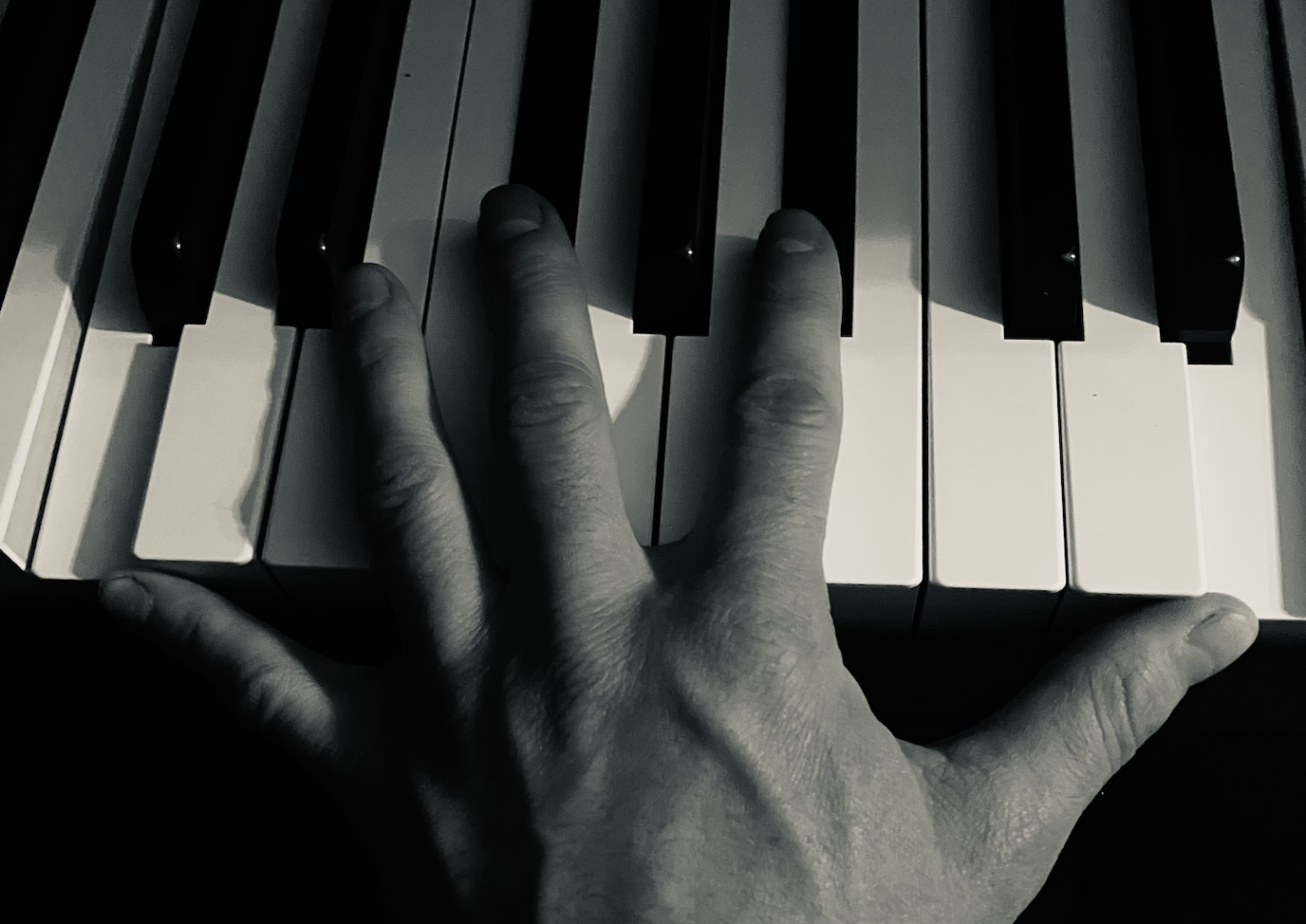
On The Mirror, Opaque
Thank you for your time and attention.
My second album, The Mirror, Opaque, feels to me a huge departure from my first album, Moments of Clarity. Where my debut album was an intensive three year project which included several trips to the studio, hundreds of creative sessions at home, and countless hours listening to the latest demos, most of The Mirror, Opaque was improvised in a single studio session in March of 2025. Where the first album featured many different instruments, sounds, and effects, this second album is instrumental solo piano.
This departure from the first album was not due to some artistic revelation or philosophical shift, but arose out of practical necessity. My last studio session for Moments of Clarity was November 18th, 2021, a week before I became a father. And since then I have become a father of two. At this point in my life, I have not the necessary resources nor capacity to make a full pop album. I have conceptual frameworks for my next two pop albums, and dozens of demos and fragments of songs exist in my own private digital spaces waiting to be developed into realized, releasable tracks, but I have chosen to dedicate my efforts to fatherhood at the expense of these unrealized albums.
And speaking of fatherhood, it was inevitably the subject of The Mirror, Opaque. For, an artist draws upon their own experience for creative expression, and my experience since 2021 has been one of total immersion in fatherhood. How is piano improvisation about fatherhood? I am glad you asked, because the creative process through which I came to recognize my own experience through my raw and unrehearsed recordings from March 2025 is what I find to be the most interesting aspect of this album, and why I am proud of it. Here is the story of The Mirror, Opaque.
On February 27th, 2025, it had been 2 years since I had released Moments of Clarity. I couldn’t help feeling a bit down, I didn’t really have anything creative to show for those last two years. Obviously, I had an excuse for that (two, in fact), but I nevertheless felt that I was really missing a big part of who I was.
Who I was…
Who was I, actually? The forces which impacted me as a child - vocal and physical tourettes, a lack of intuitive social skills, and the death of my mother, among others - led my organism to prefer the internal experiences over the external. What followed was a growing sense of identity in the cultivation of individual talents, curiosities, and values. Though I have cultivated gratitude for them, as I consider myself lucky on many counts, I have never identified with the inevitable and inadvertent circumstances of my organism, but rather, with my own personal pride and enjoyment in my own inner experience.
You can understand then, perhaps, how completely destabilizing it was to become a father. Now, having wanted to be a father ever since I’d considered the possibility, naturally I had anticipated some sort of process of trading many personal freedoms for a huge increase in responsibility. I knew I would have to change my lifestyle, sacrifice time spent pursuing interests, shift my focus to another’s needs; and therefore, I knew I was going to have some sort of identity crisis.
There is a difference, however, between understanding something in theory and experiencing it in practice. Quincy arrived, and the shift was immediate. My experience was dominated by sleep deprivation and my mental energy was encompassed in learning a new role, a new way of being. I no longer had access to certain aspects of that inner life that grounded me, rather, I was experiencing higher amounts of shame, guilt, and self-loathing than I had in a long time as I routinely failed to reach my parental ideals.
And yet, there has never been regret in the path chosen. Being a father figure in a family unit is a truly special experience. Watching my wife, Teresa, be a mother is a truly gratifying experience. Seeing my kids start to develop their different personalities and curiosities connects me with my humanity - something that I usually use art for - in a new way. Fatherhood is, simply, all-encompassing, and part of working with this crisis of identity is to accept this, one mess, one family ritual, one meltdown, and one teaching moment at a time.
Back to the timeline: I was feeling the need to create two years after my debut album was released, but knew anything too big wouldn’t get finished. I had been previously uploading daily improvisations to YouTube, but had lost track of that. Even so, it kept the idea of improvising in the forefront of my mind, and an improvisation album struck me as a straightforward enough project to follow-through with. I scheduled a session with Steve from Wild Sound, who produced Moments of Clarity, and in the weeks leading up to the session I carved out time to improvise at the piano.
The session was very enjoyable. It felt great to be back in that space, great to be creating once again. I started by improvising freely for a while. When that started to dry up, I had Steve give me some improvisational prompts to change the energy. We also explored various delay effects.
I left the studio with 37 tracks to listen to, with the next step being to figure out what it meant to me, and what to present to a listener. For the first few weeks, I listened to the tracks frequently. The initial task, as I had conceived it, was to whittle it down to usable material. A few of the tracks were the beginning, middle, and end of a perfectly good improvisation, but many were stops and starts of fragments that either did not develop, or ended abruptly when I played something that I deemed an error in the moment. There were also multiple takes of textures or ideas that I liked, but needed multiple tries to make into something that pleased me. Already in those first few weeks, however, I found myself unable to stop myself from applying extramusical significance to the tracks; naturally those narratives and images were about fatherhood.
For instance, when I hear track 2, Two Little Ones, the two voices, interacting in baroque style, give me an image of my two kids playing together. Sparkle Smash vs the Dino, track 5, strikes me as a playful battle between two characters. And track 10, which I titled Late-Night Laundry Rag, is just a stereotypical rag, but the specific delay effect (doppler) reminds me of that state of trying to keep things rolling despite being out of battery.
After the first few weeks, however, the flow of this project was interrupted, and I ultimately didn’t return to it seriously for several months. It wasn’t until February rolled around again - and with it the anticipation of seasonal depression, and with that the strategy of using creative work to stave off said depression - that I came back to the project in earnest. It was then that I came up with my desired order of the material I had chosen, and titled the few that were yet unnamed. I had two different versions of the (more-or-less) same improvisation that I liked. I realized that one of them should be called The Opaque Mirror, which was my image for my identity crisis. The reprise and album title track, The Mirror, Opaque, is worded thus as a symbol of my acceptance of my identity being unfixed, unknown, fluid, searched for.
I consider this album to be, foremost, an act of self love. It is a way to express certain experiences I have - namely the ones that comprise the titles of tracks 11, 12, and 13 - and embrace them as part of the experience of being a parent.
This album is also a way to connect with my mother. The process of grieving my mother lies in realizing what I wanted to share with her, and what I know she would have wanted to share with me. When her grandchildren were born, this grief increased. In track 14, I imagine a dialogue with her.
And finally, this album is also an expression of my love for Teresa. She is truly an amazing woman, and has really thrived in motherhood. She has been in the process of becoming a marriage and family therapist, all while being our emotional rock at home. My fatherhood journey is a product of our lives together and the future we are building, and I hear what she means to me all through the album, but particularly in tracks 4 and 18.
I went back into the studio in late February. There, I told Steve which tracks - or snippets of tracks - I wanted from the original bank of 37, and I added some musical periods and exclamation points to certain fragments that would have otherwise had an abrupt ending.
And now, at last, I have another presentation for you. Thank you very much, once more, for your time and attention, and I hope you enjoy The Mirror, Opaque!
Acknowledgements:
Thank you to my producer Steve Kaul from Wild Sound, who has a highly cultivated musical ear, and helped guide me with great suggestions and various prompts the day of the improvisation session.
Thank you to my wife, Teresa, for being such a reliable force in my life, and a primary source of inspiration for my art.
Thank you to my kids, Quincy and Harrison, who fill my life with…well…everything.
Thank you to Sherry Perra, who gave me the opportunity to get back in the studio and work on a project of hers, and helped me remember how much I loved creating music.
Thank you to all of the young parents in my local universe, who help me navigate this journey of fatherhood.
Thank you to all of my students, who come up with such wonderful ideas when we improvise in our lessons, which help shape my artistic voice!
One quick shoutout to Owen Benson, a former student of mine. We would improvise together often as part of our lessons. One of the recurring improvisational ideas in this album I trace back to one of our sessions.